Most remote workers focus on currency conversion and ignore tax compliance. Rightly so, it is a direct increase in the money you receive in your bank account.
For the few that want to ensure the Income tax department can not come for them with fines and penalties. This article is for you.
How India taxes your income
Remote IT roles with foreign companies operate as independent contractors. You decide how the work is done. You are not on the Indian payroll. You raise invoices and/or receive fixed payments. Indian tax law treats this income as business or professional income.
Which statement you need to file
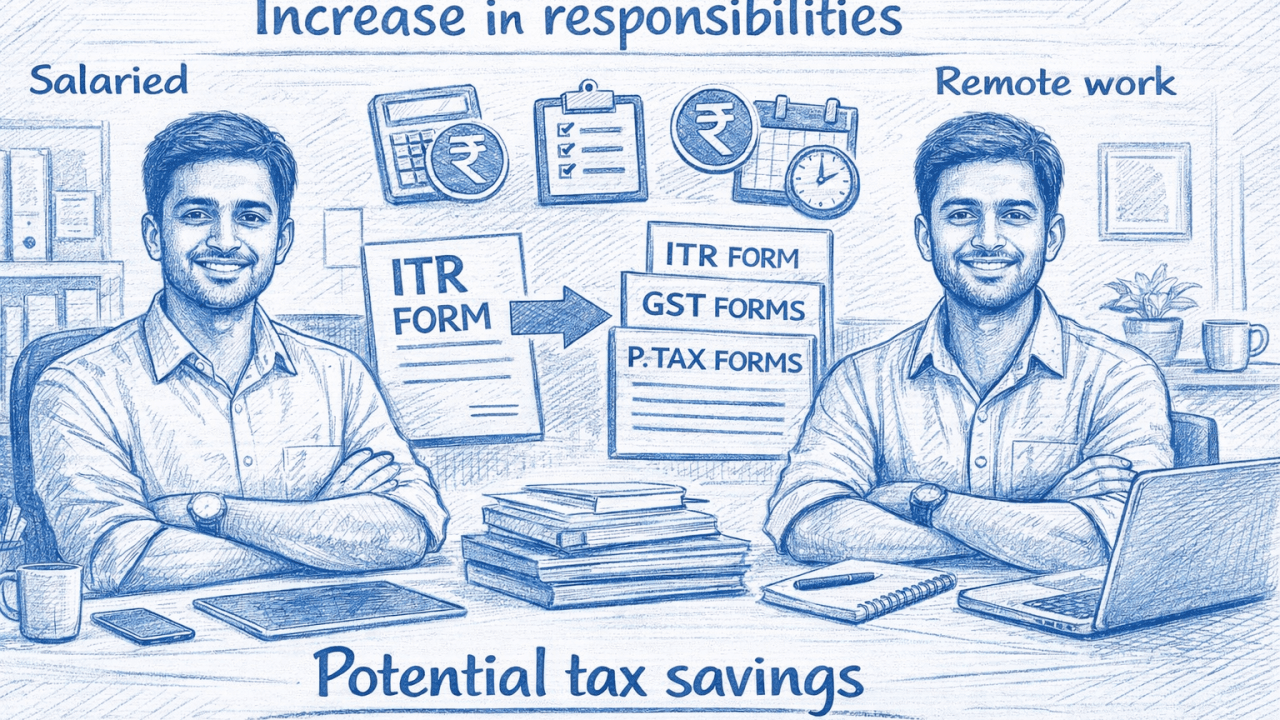
Most IT professionals start their careers on an Indian payroll. In that phase, they file ITR-1 or ITR-2.
When you work remotely for a foreign company, this changes. You are no longer on an Indian payroll. You receive payments from outside India.
Indian laws treat this income as Income from Business or Profession.
Because of this change, you must file:
- ITR-3 or
- ITR-4 (if eligible)
You cannot file ITR-4 if you have(common issues):
- Any foreign assets
- Any unlisted shares
- Any long-term capital gains
If you file ITR-4 despite these restrictions, you will receive an income tax notice. Because most remote IT workers follow Section 44ADA, the return selection is based on eligibility and disclosures rather than claiming expenses.
Presumptive taxation under Section 44ADA
IT freelancers and remote workers must follow Section 44ADA when it applies.
This section applies when:
- gross receipts from profession do not exceed Rs. 75 lakh in the year from 1 April to 31 March and
- at least 95 percent of receipts come through banking modes. Crypto, shares, or similar modes do not qualify.
Under this section, fifty percent of gross receipts is treated as taxable income. Expense records are not required. Further deductions are not allowed.
Example
Assume you earn Rs. 60 lakh during the year and receive all payments through bank transfer. Your taxable professional income becomes Rs. 30 lakh.
This rule applies only to professional income. It does not apply to salary, capital gains, or interest.
Currency Conversion
Indian tax records income only in rupees.
If the foreign company pays you and the money reaches your Indian bank account before you file your statement, the rupee amount credited by the bank is your income. This amount already includes conversion charges.
Rule 115 of the Income Tax Rules applies only when payment is not received before filing. In such unpaid cases, you must convert the foreign amount using the SBI Telegraphic Transfer Buying Rate. You use the rate of the last day of the month before the month in which you provided the service.
If payment is credited before filing, Rule 115 does not apply.
Example. Rohit works from India for a UK company. He earns GBP 5,000 for May 2024. The payment reaches his Indian bank on 10 June 2024. If the bank credits Rs. 5,18,000, that amount is reported as income.
Advance tax
Advance tax is part of the tax you must pay during the year in which you earn the income, instead of paying the full amount at the time of filing the return.
Advance tax applies when your total tax payable exceeds Rs. 10,000. Salary income has tax cut before payment. Professional income does not.
Section 44ADA gives relief for advance tax. For professional income covered under this section, you can pay the full advance tax by 15 March. Earlier dates do not apply to this income.
If you earn capital gains or other income, advance tax rules for those amounts apply separately.
If you miss the advance tax payments, interest at 1% per month applies.
When GST applies
GST applies when you provide services as a contractor. GST registration depends on turnover. For services, registration becomes compulsory when turnover crosses Rs. 20 lakh in most states and Rs. 10 lakh in special category states.
If you export services and your turnover stays within this limit, GST registration is not required, unless a compulsory registration rule applies.
If GST registration is required, you can file a Letter of Undertaking (LUT). LUT allows you to export services without charging GST.
If GST registration is not required, GST does not apply. In this case, filing LUT is not required.
GST registration becomes compulsory in certain cases even when turnover stays below the limit. Section 24 of the CGST Act applies when you supply taxable services through an e-commerce operator, act as an agent for another taxable person, pay GST under reverse charge for notified services, or fall under a category notified by the government.
What is Form 16 and why a foreign company does not issue it
Form 16 is a salary tax certificate. Indian employers issue it because they must deduct tax before paying salary.
Foreign companies do not follow Indian payroll law. They do not deduct Indian tax. They do not issue Form 16.
This does not make your income tax-free. You must calculate tax on your own and file the statement using invoices and bank credits.
Foreign assets and penalty
Foreign assets mean financial items held outside India. This includes foreign bank accounts, Wise balances, PayPal balances, foreign brokerage accounts.
If you are a resident, you must disclose foreign assets and foreign income in Schedule FA.
Failure to file the statement when foreign assets exist attracts a penalty of Rs. 10 lakh under the Black Money Act. This penalty does not apply to foreign movable assets when their total value does not exceed Rs. 20 lakh during the year.
This relief applies only to the penalty. Disclosure is mandatory.
Foreign tax cut
US companies ask for Form W-8BEN, which confirms that you are not a US person and that you are a tax resident of India.
- If Form W-8BEN is submitted and the work is done from India, no US tax is cut under the India-US DTAA.
- If Form W-8BEN is not submitted, US companies are required to withhold taxes as per the local law
Even when the foreign tax is cut, you must report the full income in India. Tax cuts outside India reduce Indian tax on the same income. This is called "Foreign Tax Credit". You claim this credit by filing Form 67 with proof of tax cut.
A simple case study
Ajay lives in Hyderabad. He works from India for a US company under a remote contract.
He earns USD 6,000 each month. Assume 1 USD equals Rs. 80. His yearly income is Rs. 57,60,000.
The US company does not cut Indian tax. All payments come through bank transfer.
Section 44ADA applies. Ajay's taxable income becomes Rs. 28,80,000.
Ajay pays advance tax by 15 March. He files ITR-3. He reports his Wise balance and US brokerage account in Schedule FA.
If US tax is cut (not normal), Ajay files Form 67 and claims Foreign Tax Credit. Important note: Even if Ajay gets Rs. 40,32,000 (57,60,000 -30% withholding) in his bank account, the reported income should be 57,60,000. Any withheld taxes (India or USA) do not reduce your total income.
{width="6.5in" height="4.333333333333333in"}