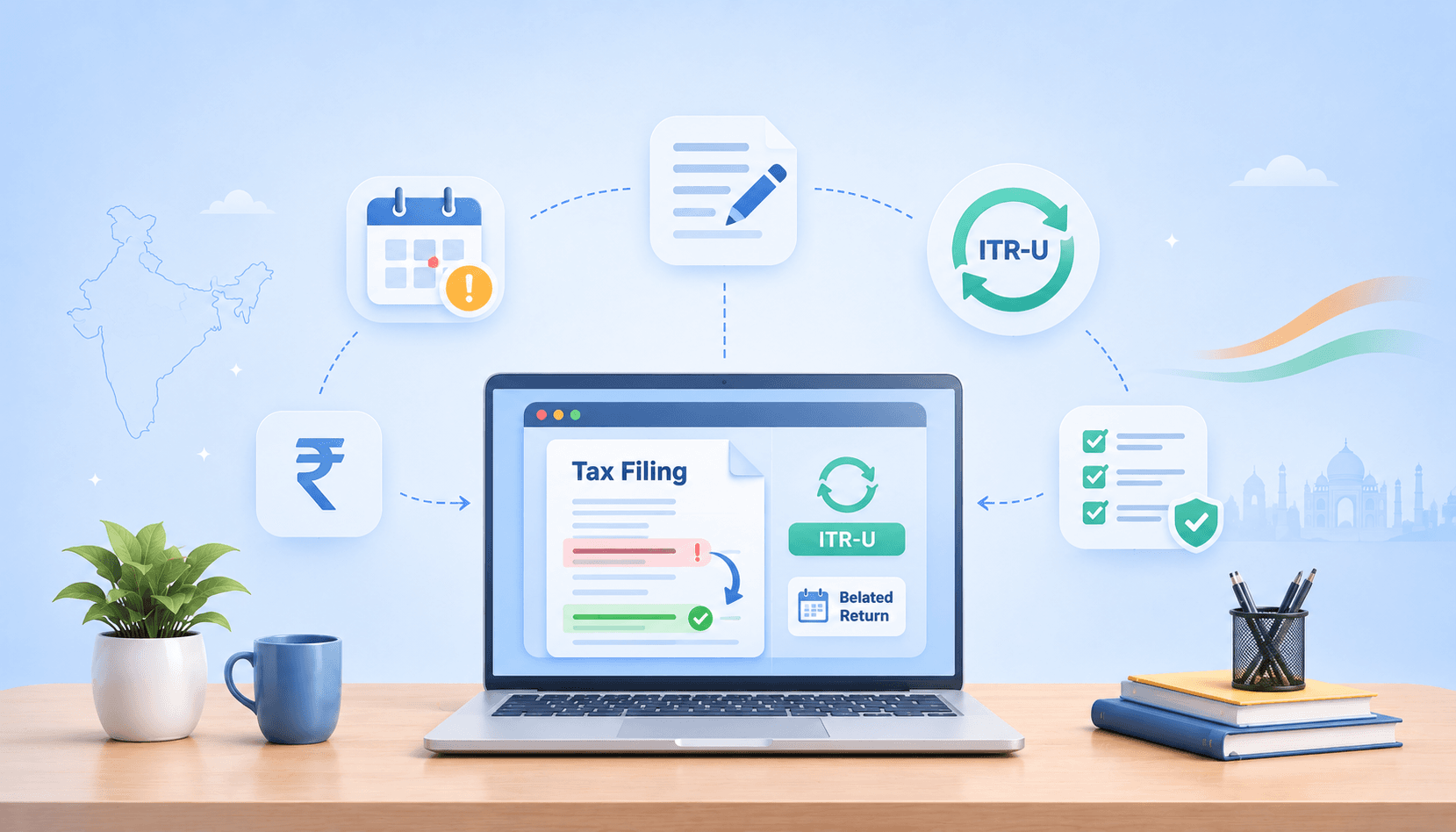
Three returns fix almost any income tax mistake: a belated return, a revised return, and an updated return.
Which one you use depends on two things: whether you filed at all and how much time has passed.
If you missed the deadline entirely, but are filing before 31st December of the year, you file a belated return. If you already filed but got something wrong, you can file a revised return up to 31st March of next year. If you find the error after that, an updated return, still widely called ITR-U, is your only option.
Filed your taxes wrong or missed the deadline? Start here
Pick your fix from where you stand. This table is for Tax Year 2026-27.
| Your situation | Which return | Last date (TY 2026-27) |
|---|---|---|
| Never filed, deadline still open | Belated return | 31 December 2027 |
| Already filed, found a mistake | Revised return | 31 March 2028 |
| Both windows closed, income still to report | Updated return (ITR-U) | 31 March 2032 |
Belated return: What if you missed the ITR deadline?
A belated return is simply an income tax return filed after the original due date. You can still file it. You just pay a late fee and, if tax is outstanding, pay the interest.
Who can file a belated return?
Anyone who missed the original filing deadline can file a belated return, as long as the belated window is still open. You do not need permission and you do not need a reason.
Deadline for Tax Year 2026-27
31 December 2027, or before your assessment is completed, whichever is earlier. That is the hard stop for a belated return covering income earned in Tax Year 2026-27.
What does filing late cost?
The late-filing fee is ₹1,000 where your total income does not exceed ₹5 lakh. In every other case it is ₹5,000. This fee is defined in Section 428 of the Income Tax Act 2025, which replaced the old Section 234F. On top of the fee, you pay interest at 1% a month on any tax that stays unpaid, calculated from the day after the due date until you file.
Example:
Take Arjun, a freelance designer in Pune. His total income for the year is ₹4.6 lakh and he files three months late. His late fee is ₹1,000, not ₹5,000, because he stays under the ₹5 lakh line. If he still owed ₹8,000 in tax when he filed, interest runs on that ₹8,000 until he clears it.
Other consequences of filing late
Filing late can cost you more than the fee. Business losses and capital losses can be carried into future years only if you file by the original ITR due date. If you file a belated return, you lose that carry-forward, which can cost far more than ₹5,000. A house-property loss and unabsorbed depreciation are not affected and still carry forward.
Revised return: What if you already filed but made a mistake?
A revised return replaces a return you have already filed. You file a fresh, corrected version and it supersedes the earlier one. There is no penalty for revising an honest error, provided you do it inside the window. Losses can be carried forward if the original return was filed within the due date.
What can you correct with a revised return?
A revised return fixes almost any error in a return you already filed. Common ones for freelancers are:
- Freelance income you forgot to include
- A deduction or business expense entered wrong
- A mismatch with your TDS or AIS (the Annual Information Statement, the tax department's own record of your income and transactions)
- Wrong personal or bank details in the return
Revised return deadline for Tax Year 2026-27
It is 31 March 2028. This window is wider than the belated-return window, so a return you filed late can still be revised.
Is there a fee for revising your return?
Revising is free while the ordinary nine-month window is open. The Finance Act 2026 extended the revised-return window to twelve months, so a revised return filed after 31 December 2027 still counts, but it carries the same late fee under Section 428, ₹1,000 or ₹5,000 depending on your income. So fix mistakes early.
The correction itself carries no penalty, but delaying the correction beyond 31st December 2027 has some late fee.
Updated return: What if you find the mistake much later?
An updated return, commonly known as ITR-U, lets you report income after the belated and revised windows have both closed. It exists for the case where you realise, long after filing season, that you left income out. You pay the tax, the interest, and an extra amount on top.
What is an updated return?
An updated return is a return you file after the normal belated and revised deadlines have passed. It is a way to come clean on income you missed and pay what is due, rather than wait for the tax department to find it. The form is called ITR-U, and it is governed by Section 263(6) of the Income Tax Act 2025.
How long can you file an updated return?
For Tax Year 2026-27, potentially up to 31 March 2032, subject to eligibility conditions. That is a much longer window than either the belated or the revised route. It is not open to everyone in every case. The restrictions below spell out when you can use it.
When can you use an updated return?
You can file an updated return only when you need to report more income or pay more tax. Typical cases:
- Income you omitted entirely, such as a client payment you never declared
- Income you under-reported
- Any situation where additional tax is due
When can't you use an updated return?
An updated return cannot be used to pay less. You cannot file one if it would reduce your tax liability, increase your refund, or increase a loss you reported. It is a one-way door. It only goes toward paying more, never toward getting money back.
How much extra tax does an updated return cost?
An updated return costs an extra percentage on top of the tax and interest you owe, set by Section 267 of the Income Tax Act 2025. The percentage applies to the additional tax and interest together, not to the omitted income itself.
The longer you wait, the higher it climbs: 25% if you file within 12 months of the revised-return window closing, 50% between 12 and 24 months, 60% between 24 and 36 months, and 70% between 36 and 48 months.
Belated vs revised vs updated return: Which should you choose?
Match the return to your situation, in this order:
- Never filed and the deadline has not passed. File a belated return.
- Already filed and the correction window is still open. File a revised return.
- Both windows have closed and you still have income or tax to report. File an updated return.
If more than one route is open, the earlier and cheaper one wins. A revised return inside its window beats an updated return every time, because it carries no extra percentage.
Common tax filing mistakes freelancers should fix
These are the errors that most often send a freelancer back to correct a return:
- Income from a client left off the return
- A mismatch between your return and your AIS or TDS records
- Business expenses claimed wrong, either too high or in the wrong head
- Foreign-client income not declared
- Presumptive tax reported incorrectly, for example the wrong turnover or the wrong percentage
- Capital gains or other income missed entirely
How to correct your return online
Work through it in order:
- Review your original return against your tax records, including your AIS and Form 26AS.
- Recalculate your correct income and the tax on it.
- Pay any additional tax, interest, or fee that comes out of that calculation.
- File the right return for your situation: belated, revised, or updated.
- E-verify it and save the acknowledgement. An unverified return is not a filed return.
When should you get professional help?
Get help before you file when the mistake is large or the stakes are high. In particular:
- A significant amount of income was left out
- Foreign income or foreign assets are involved
- An updated return is required, given the extra tax and the eligibility conditions
- You have already received an income tax notice
- The correction involves losses, refunds, or a substantial tax bill
In these cases, a wrong fix can cost more than the original mistake. An updated return, especially, is worth getting right the first time.
How Remote Munshi can help you fix tax filing mistakes
Remote Munshi offers comprehensive tax management services and handles the full correction, start to finish.
We review your original return, reconcile it against your AIS, Form 26AS, and TDS records, and work out the corrected income and tax. We then file the right return for you, belated, revised, or updated, and handle the tax calculation and payment that goes with it. If a notice has already landed, we manage the response too.
Consult with our tax experts at Remote Munshi
FAQs on how to fix filing mistakes
Can a belated return be revised?
Yes. A belated return can be revised within the revised-return window, which for Tax Year 2026-27 runs to 31 March 2028, or before your assessment is completed, whichever is earlier.
How many times can I revise my ITR?
You can revise more than once within the window, each revision replacing the last. There is no cap in Section 263(5) of the Income Tax Act 2025 on the number of revisions. Frequent revisions can cause errors. Should be avoided.
Can I file a belated return after 31 December 2027?
No. After 31 December 2027 the belated window for Tax Year 2026-27 has closed. If you still need to report income, your route is an updated return, provided you meet its conditions.
Can I use an updated return to claim a larger refund?
No. An updated return cannot reduce your tax, increase your refund, or increase a reported loss. It only goes toward paying more tax.
How far back can I file an updated return?
For Tax Year 2026-27, potentially up to 31 March 2032, subject to eligibility conditions. That is a longer window than the belated or revised routes.
Is ITR-U still called ITR-U in Tax Year 2026-27?
The updated-return form is ITR-U.