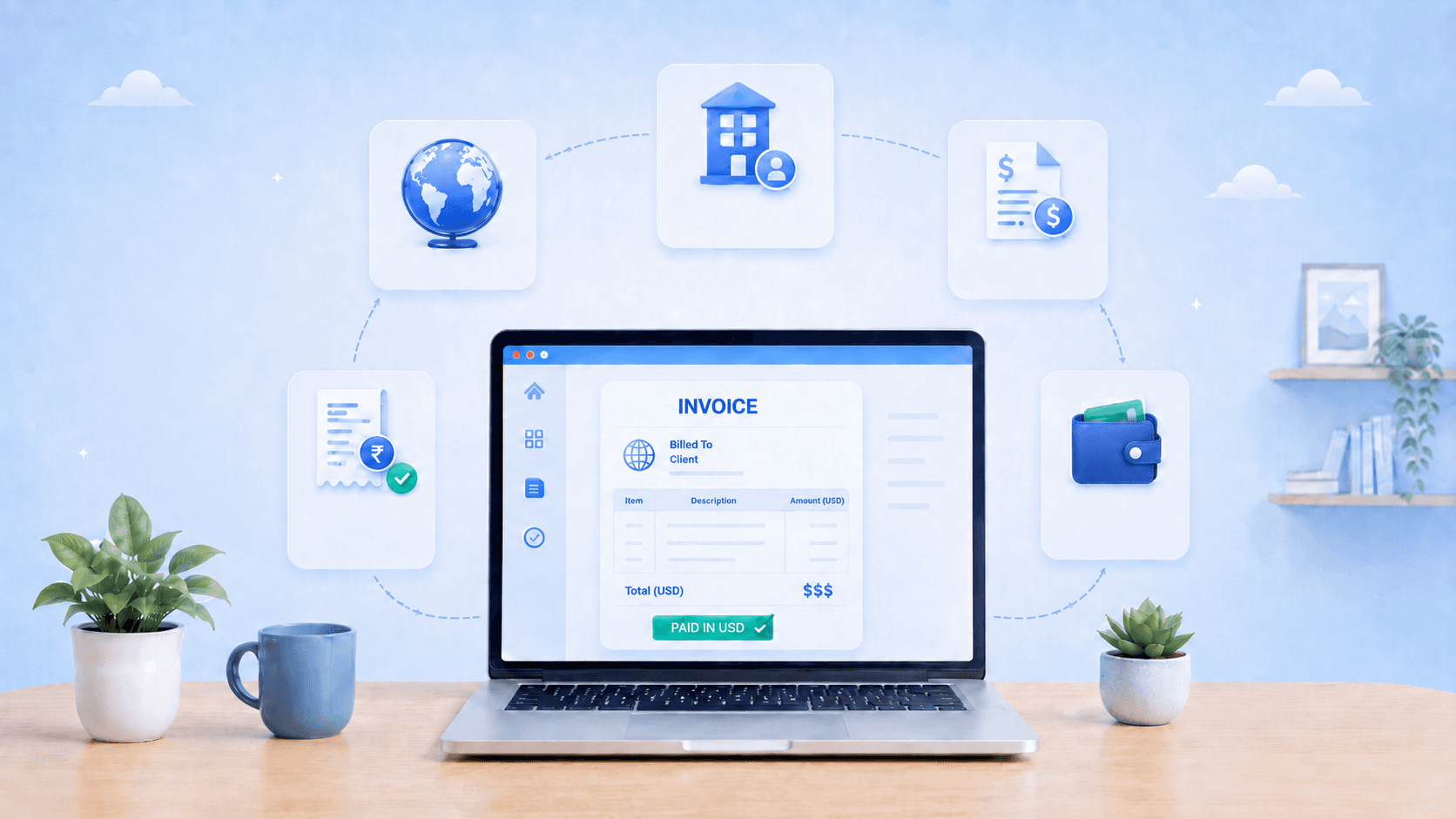
GST registered Indian freelancers and service exporters must issue a foreign client invoice with GST details, SAC code, LUT declaration, bank details and service description.
You might argue that all this trouble comes with GST registration. Then you will simply not get registered in the first place. Fair point. But if your revenue is more than 20LPA, you need to get GST registration. This is the law. Not doing so means the government can ask you to pay 36% of your revenue. That is scary.
Also, payments must come through an authorised banking channel with the correct RBI purpose code. From October 1, 2026, service exporters must also prepare for EDF filing.
Why does receiving foreign payment require compliance at all?
When an Indian freelancer, consultant, agency, or remote software developer receives money from a foreign client, the transaction enters the FEMA framework.
FEMA (Foreign Exchange Management Act, 1999) governs foreign currency entering India. FEMA does this through a system called Export Data Processing and Monitoring System (EDPMS). All banking transactions where a foreign bank or branch is involved get entered into this system.
For an Indian freelancer, the banks complete the FEMA processes for you. Your bank reports the foreign receipt to RBI systems. This is why the bank asks for an invoice, purpose code, client details, and supporting documents.
What is required under FEMA law?
Payment must come through an authorised route, the purpose code must match the nature of work, and export proceeds must be realized within the applicable FEMA timeline.
From June 5, 2026, to September 30, 2026, the amended 2015 regulations prescribe 9 months. From October 1, 2026, the 2026 regulations prescribe 15 months from the invoice date for services.
Also, “authorised route” means banking channels. “Purpose code” is the numbering system used to classify your services. For Software developers, the purpose code is P0802. For Google ads manager, content managers and writers: the purpose code is P1006. You must inform the bank to use the correct purpose code.
What goes on the invoice?
Your invoice to foreign clients has to meet requirements for: your client, bank, GST and Income tax department.
Mandatory fields for every foreign invoice
Your invoice should contain your:
- Trade name or Full legal name
- Business address (if any) or your primary address
- GST number (where registered)
- Invoice number
- Invoice date
- Client’s Trade name or full legal name
- Client’s office address (outside India)
- Service description
- SAC code
- Invoice value in foreign currency
- INR equivalent (recommended)
- Exchange rate reference (recommended)
- Payment terms
- Bank details
- Bank SWIFT code
If you are exporting services under LUT, add this declaration on the invoice (in header):
“Supply meant for export under LUT without payment of IGST.”
The invoice date is important because it starts the FEMA payment timeline.
Also, here are the instructions regarding invoice numbering:
- Keep the invoice numbers sequential. Anyone should be able to guess the next and the previous invoice number by looking at your invoice. Also, do not use alphabets for sequences
- Avoid separate series for each client
- Any prefix/suffix is ok
- Length of the invoice number should not be more than 16 characters
Examples of good Invoice numbers:
- INV-01
- INV-2026-01
- EXP-01
SAC codes for common freelance services
SAC code is the numbering system used to classify your services.
Use the SAC code that matches the actual work done under the contract. Do not select the code based only on job title.
| Service Type | SAC Code | Description |
|---|---|---|
| Software development / IT consultancy | 998314 | Information technology design and development services |
| Web development | 998314 | Development of websites or web applications |
| Web / graphic design | 998391 | Design services |
| Digital marketing/advertising | 998361 | Advertising services |
| Internet ad space sales | 998365 | Sale of internet advertising space |
| Business/management consulting | 998311 | Management consulting services |
| Graphic design | 998391 | Design services |
| Technical writing | 998392 / 998399 | Technical/scientific consulting or other professional services |
| General professional services | 998399 | Other professional, technical and business services |
For unclear work, such as a founder doing product strategy, software advisory, and implementation support in one engagement, confirm the SAC with a CA before issuing the invoice. A wrong SAC creates GST classification questions during scrutiny and refund review.
Do you need a GSTIN to invoice foreign clients?
GST registration depends on turnover and the type of transaction.
If your total revenue from services exceeds Rs. 20 lakh in a financial year in normal category States, GST registration is compulsory.
In special category States like Assam, Himachal Pradesh or Uttarakhand, the turnover limit is Rs. 10 lakh.
If you are below the registration threshold, you can skip GST registration for now.
There are some other conditions due to which you might be required to get GST registration. But, these rarely apply for Indian freelancers and remote workers. Hence, these are not discussed here.
Which purpose code should you use?
A purpose code is the RBI classification tag for foreign money movement. Inward foreign receipts use “P” codes. Outward payments use “S” codes.
Your bank asks for a purpose code because it must classify and report every foreign credit. The code should match the service description in the invoice and contract.
A software developer should not classify client fees as a gift. A marketing consultant should not use a software code unless the work is software-related. A wrong purpose code leads to bank queries, delayed remittance closure, and document mismatch.
Common purpose codes for Indian freelancers
| Service Category | RBI Purpose Code |
|---|---|
| Software implementation/consultancy (not covered under SOFTEX) | P0802 |
| Google ads management or content management | P1006 |
| Information services, data processing | P0806 |
| Off-site software exports | P0807 |
| Business and management consultancy | P0805 |
| Advertising, market research, public opinion polling | P0803 |
| Professional and management consulting | P0805 |
| Education and training services | P0804 |
Always inform the exact purpose code to your bank before every receipt.
Many foreign banks capture the purpose code during the remittance setup. If the wrong code arrives, the freelancer must contact their bank's forex desk, submit the UTR number, correct purpose code and supporting invoice to request a corrected e-FIRC.
What happens after payment arrives: FIRA, FIRC, and what to collect
Once the foreign payment reaches your Indian bank, the bank links the payment to a purpose code and supporting documents.
For contractor or freelance income, the bank may ask for the invoice. Banks may also ask for the contract if they need more documents. For platform payments, keep the platform statement, client invoice, bank credit advice and remittance proof.
In my experience, government banks ask for more documents than private banks.
After processing, the bank issues inward remittance proof. Depending on the bank or payment route, this may be called Credit Advice, FIRA, e-FIRA, FIRC, FIRS, inward remittance advice, or bank realisation proof.
The EDF transition: What changes from October 2026
Right now, the freelancers and remote workers are not required to file any form with FEMA or the banks. That changes from October 2026.
Regulatory shift from SOFTEX to EDF:
- From October 1, 2026, SOFTEX is removed and replaced by a single Export Declaration Form (EDF) under FEMA 23(R)/2026-RB
- These Regulations were notified on January 13, 2026 and will come into force on October 1, 2026
- Every service exporter including freelancers across all sectors, must file EDF through their Authorised Dealer (AD) bank
EDF filing timeline and consolidation:
- EDF must be filed within 30 days from the end of the month in which the invoice is raised
- You can file one consolidated EDF per month covering multiple invoices and even multiple clients for that month
Earlier, freelancers and remote workers were not required to file any forms for receiving payments from outside of India. From October 2026, the banks will start asking you for the required details and documents for filing the Export Declaration Form. You do not have to file these on your own.
Role of purpose codes under the new regime:
- Purpose codes are characters used to classify your services. Filing EDF is mandatory regardless of the code used
- Earlier, codes like P0802 were except from filing Softex or any other forms
- Under the 2026 regulations, exporters of services must file EDF. The ₹10 lakh threshold is not an exemption from EDF filing. It is only a simplified EDPMS closure facility after realisation
Filing authority and bank processes:
- EDF filing is handled primarily through your AD bank, which is now recognised as a “Specified Authority” alongside STPI and SEZ units
- STPI certification will not be required for freelancers and remote workers, but banks with limited knowledge may define their own processes, so requirements can vary
Self-declaration for small-value invoices:
For invoices up to ₹10 lakh, you can use self-declaration to close the EDPMS entry instead of waiting for full bank processing. This facility continues under the new framework for small-value transactions.
Before October 2026, confirm with your bank:
- Will EDF apply to your exports
- Will monthly filing be allowed
- What documents are required
- How self-declaration will work for small invoices
- How submissions will be made (portal or email)
Continue using the correct purpose code but treat EDF filing as a separate mandatory step.
Do you need to charge GST on foreign client invoices?
GST applies to services supplied from India. Export of services is zero-rated under Section 16 of the IGST Act, 2017. You will still have to complete the Export of Services conditions specified in the GST Act 2017
Under Section 2(6) of the IGST Act, your services must meet these conditions to be called export of services:
- The supplier (your business address) is located in India
- The recipient is located outside India
- The place of supply is outside India
- Payment is received in convertible foreign exchange or in permitted INR
- Supplier and recipient are not merely establishments of the same person
Important
If these conditions are met and you have a valid LUT, you raise the invoice at 0% GST without payment of IGST. If you meet the conditions but do not have a valid letter of Undertaking, you need to charge 18% GST on your services and apply for a GST refund.
Note
If the contract is with the Indian company of a foreign group, the transaction is domestic. In that case, GST must be charged if you are registered and the supply is taxable. The foreign brand name on emails does not decide GST treatment. The contracting entity decides the tax position.
Filing the LUT: What it is and when to do it
The full form of LUT is Letter of Undertaking. A GST-registered exporter files LUT in Form GST RFD-11 on the GST portal. This allows you to export services without payment of IGST.
LUT is valid for one financial year. File it before raising export invoices for that year. Once filed, download the ARN acknowledgment and save it. If this is your first year of GST registration, file Letter of Undertaking after getting GST registered.
Without LUT, a registered exporter has to pay IGST on the export invoice and then claim refund. This blocks working capital and adds refund paperwork.
With LUT, the invoice is raised without IGST. Make sure that your invoice has the LUT declaration.
How to report the export in GST returns
Once you are GST registered, return filing continues even when every invoice is zero-rated. It continues even when the GST payments are zero.
In GSTR-1, report export invoices with invoice number, date, value, place of supply, and LUT status.
In GSTR-3B, report the value under zero-rated outward supplies. Where exports are under LUT, output GST liability remains nil. Where exports are made with payment of IGST, tax payment and refund route apply.
Do not file nil returns when you have export invoices. Zero tax does not mean zero reporting.
Common mistakes and how to avoid them
Wrong or missing purpose code
Pick the purpose code that matches the nature of your services. Keep the same code pattern for the same type of work. If the bank flags a mismatch, submit the invoice, contract, UTR, and correct purpose code to the forex desk.
Receiving payment into a personal savings account
Use a bank account that supports foreign inward remittance documentation. A current account makes bank paperwork cleaner. Your tax filing must match the bank trail. This is also required as per RBI guidelines.
Using crypto or informal channels
Do not accept client payments through crypto, hawala, or informal settlement. Export income needs an authorised banking trail. Without it, FEMA, GST, and income tax documentation breaks down. You will also be required to pay 18% GST.
Forgetting to renew the LUT
LUT must be renewed every financial year. If you raise export invoices without a valid LUT, the clean zero-rated route is lost and IGST refund paperwork follows.
Not collecting FIRA promptly
Collect FIRA, e-FIRC, or inward remittance proof soon after payment. Store it with the invoice and contract. Do not wait until GST refund filing, income tax assessment, or bank follow-up.
Focus on your international clients, not tax paperwork.
Let an experienced CA manage the compliance.
FAQs on how to invoice foreign clients from India
Do I need an IEC to bill foreign clients?
IEC is not required for export of services.
Can I hold the foreign currency in my bank account and convert later?
If you want to retain foreign currency, ask your bank about an EEFC account. A normal savings or current account converts the inward remittance immediately.
My client pays me through Deel. Who is responsible for FEMA compliance?
You remain responsible for your Indian tax and FEMA documentation. Keep the client contract, invoice, platform statement, bank credit advice, purpose code record and e-FIRC.
What is the penalty for using the wrong purpose code?
A wrong purpose code leads to bank queries, delayed remittance processing, and mismatch in records. Penalty exposure depends on facts, FEMA assessment, documents, and whether there is a reporting failure or misclassification. The process is the penalty.
I earn below Rs. 20 lakh. Do I still need GST registration to invoice a foreign client?
No, GST registration is not required below Rs. 20 lakh in normal category states.
What happens to SOFTEX filings from before October 2026?
SOFTEX filings made before October 1, 2026 should be preserved with invoice and bank records. From October 1, 2026, follow the EDF process and confirm with your AD bank whether the filing will be handled through the bank, STPI, or another specified authority based on your export category.