Title: All the registrations you need as an Indian Remote Worker
TL;DR
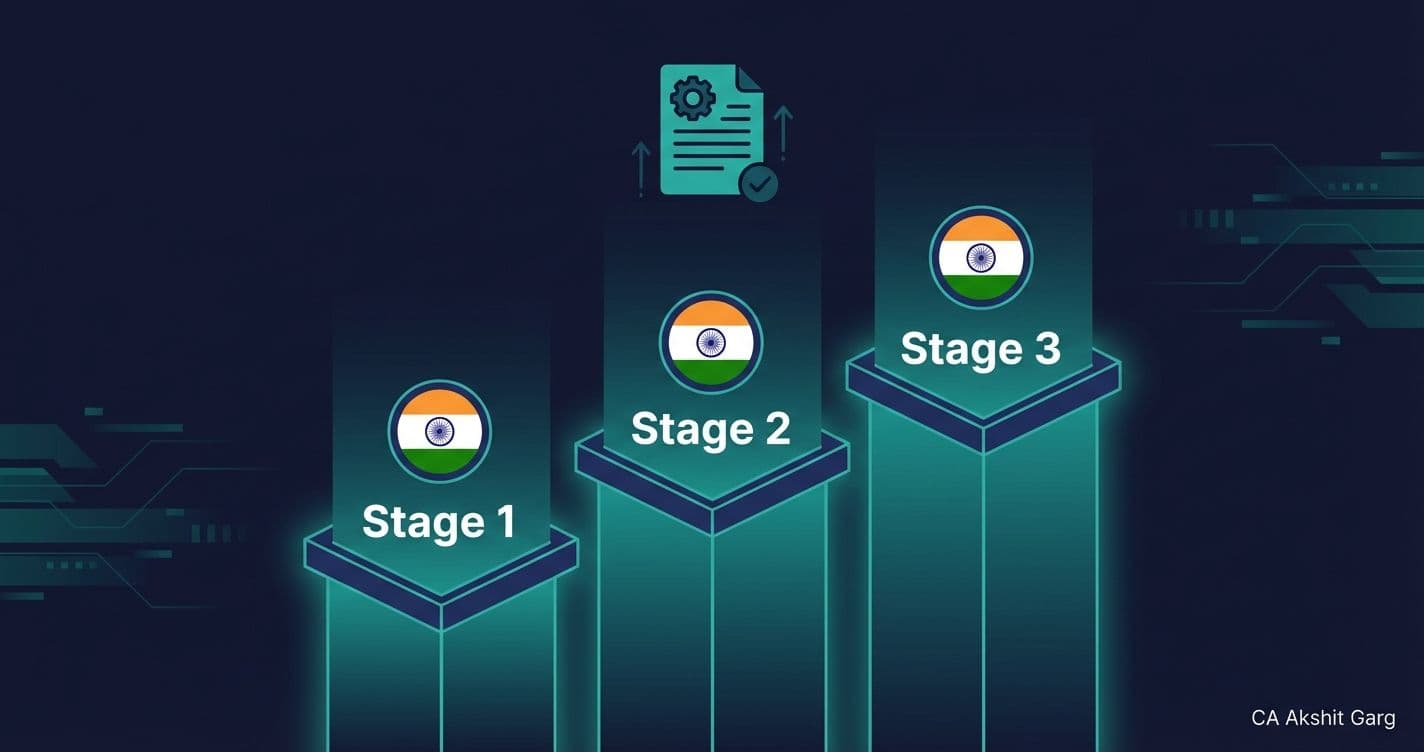
- There are three stages of registrations for a remote worker or freelancer.
- Stage 1 is the Income Tax stage. PAN, Income Tax portal registration and the correct ITR form (ITR-3 or ITR-4 when eligible) apply.
- Stage 2 is the GST stage. GSTIN becomes mandatory after ₹20 lakh turnover (₹10 lakh in special category states). LUT and e-FIRC are required for export of services.
- Stage 2.5 is the Professional Tax stage. As a GST registered business, you are required to register for and pay professional tax in most states. Few states like Karnataka, Telangana, Tamil Nadu and Maharashtra send notices to collect the professional tax.
Indian law requires registrations at different stages. Let's go through each
Stage 1: You Work Alone, You Get Paid from Outside India (but less than 20LPA)
1) PAN & Income Tax portal Registration
You need a PAN number for all tax matters. Also link it to Aadhaar. It is compulsory.
Steps to get a PAN card:
- If you don't have one, then apply online on NSDL or UTIITSL website.
- Submit identity proof like passport and address proof like utility bill.
- The process takes 15 days. If you choose to get a physical PAN, PAN card arrives by post.
Income Tax portal registration steps :
- Visit incometax.gov.in.
- Click Register.
- Select Individual.
- Enter PAN and date of birth.
- Enter mobile number and email.
- Verify details using OTP.
- Set username and password.
- Log in to the portal.
- Link Aadhaar if not already linked.
2) Correct ITR form: ITR-3 or ITR-4 (when eligible)
Remote contract income is categorised under Business/Profession. Business/Profession Income goes into ITR-3 or ITR-4.
You must file:
- ITR-3 (Over 90 pages) or
- ITR-4 (when eligible) (it is a shorter form- less than 20 pages)
ITR-4 does not apply if you have:
- any foreign assets
- any unlisted shares
- any long-term capital gains
Foreign assets include:
- Foreign bank accounts
- Wise balance
- PayPal balance
- Foreign brokerage accounts
If you are a resident, you must disclose foreign assets in Schedule FA.
3) GST Registration (Not recommended at this stage)
You do not need GST registration just to receive payments from outside of India.
Important : GST registration is not required if your service turnover stays below ₹20 lakh.
In other words, no GSTIN is needed at this stage.
Stage 2: You cross ₹20 lakh turnover from services (Yay!)
More than half of Full time contractors start directly at stage 2.
1) GSTIN becomes mandatory
After crossing the threshold:
- GST registration is compulsory
- You now have to follow the GST law
GST registration applies at:
- ₹20 lakh in most states
- ₹10 lakh in special category states
Special category states are: Arunachal Pradesh, Assam, Himachal Pradesh, Jammu & Kashmir, Manipur, Meghalaya, Mizoram, Nagaland, Sikkim, Tripura, Uttarakhand.
2) How to register (will share detailed guide later)
- Go to https://reg.gst.gov.in/registration/
- Fill out the registration form
- A TRN (Temporary Reference Number) is generated.
- Log in using TRN.
- Complete the application within 15 days.
- After successful submission, an ARN (Application Reference Number) is issued and GST is approved in 1 day
3) Business setup
If you export services with GST registration (like most IT freelancers do), your export setup has three pillars.
LUT means Letter of Undertaking.
A) LUT
It is a declaration you submit on the GST portal. It tells the GST department that you will not charge GST on your export invoices and follow export rules.
You file LUT so export invoices stay at 0% GST.
#### B) Invoice discipline
Your invoices must clearly show:
- invoice date
- invoice number
- client details
- service description
- value in foreign currency and INR value for reporting
For GST valuation:
- If payment reaches your bank before filing the GST return for that period, you use the actual INR credited by the bank
- If payment does not reach before filing, you convert using the spot rate on invoice date (SBI TTBR on invoice date)
#### C) e-FIRC record (your only proof of being an exporter)
e-FIRC means electronic Foreign Inward Remittance Certificate.
It is a bank document. It confirms that:
- money came from outside India
- the sender is a foreign client
- the money was received for export of services
You must collect bank e-FIRC for each receipt.
Stage 3: You hire or build a team
This stage starts when you pay other people to help you deliver work.
Your compliance shifts from "solo professional" to "business with staff and vendors".
1) Shops & Establishment Registration (State law)
Shops & Establishment is a state law registration for establishments. If your state law covers your setup, registration becomes a requirement.
This becomes important when you have:
- an office setup
- employees working under you
- a place of business that the state treats as an establishment
2) Professional Tax Registration (State law)
Professional Tax is a state subject. If your state asks you to pay, you pay.
Two roles exist:
- enrolment for self-employed professionals (this is the one applicable to you)
- employer registration to deduct and deposit PT for employees
3) TAN (Tax Deduction Account Number) (only if you hire other contractors)
The day you start paying contractors, consultants or freelancers AND if your revenue crossed 50LPA in previous year, you must start taking care of TDS rules as well.
- You must obtain TAN \> deduct TDS \> deposit TDS \> file TDS forms
This becomes a common trigger for small remote teams.
4) PF/ESI registrations (only if you hire people on job)
PF registration becomes mandatory when you have 20 or more employees in your establishment.
At that point:
- registration becomes mandatory
- monthly compliance becomes mandatory
ESI registration depends on:
- your state coverage under ESI law
- employee count
- employee salary eligibility
Once applicable:
- registration becomes mandatory
- eligible employees must be enrolled
- monthly compliance becomes mandatory